We brought Leon’s sculpture studio “home” by erecting a shed on the north side of our property. This involved removing the existing mass of trees, shrubs, and perennials that were there and provided some wide open and sunny spaces for a whole new garden.
I have so many plants I propagated in the last year. Of course, they are a random mix of ornamental and native plants that have no business being planted together. But they also happen to be some of my favorite plants, and the price is right, so I decided to use them as the framework for the garden and build around them. Leon is partial to hollyhocks, and I started a bunch of them from seeds we pilfered at a winery in Lodi last summer. I planted what should ultimately be a wall of hollyhocks close to his studio (Bedrock). They are not native, but they should attract some pollinators. Along the northeast fence line, I tucked in three seedlings of tall Oregon grape (Mahonia aquifolium) and three small cuttings of red-flowering currant (Ribes sanguineum). These shrubs may take a few years to reach flowering size, but they should grow faster in the ground than in pots. They should attract lots of hummingbirds in early spring.
I had a healthy start of Douglas aster (Symphyotrichum subspicatum) and tucked that in a corner where its robust spreading will not cause any problems and its late summer flowers will attract a million native bees and skipper butterflies.
I had two tiny big-leaved lupine (Lupinus polyphyllus) seedlings to plant near the front of the garden. Their blue-purple flowers will attract native bumblebees in May.
Nearby, I planted three honey balm (Melittis xRoyal Velvet Distinction), a plant I have been hoping to grow for years, and finally got some starts going last autumn. They are not native here but are said to be good pollinator plants.
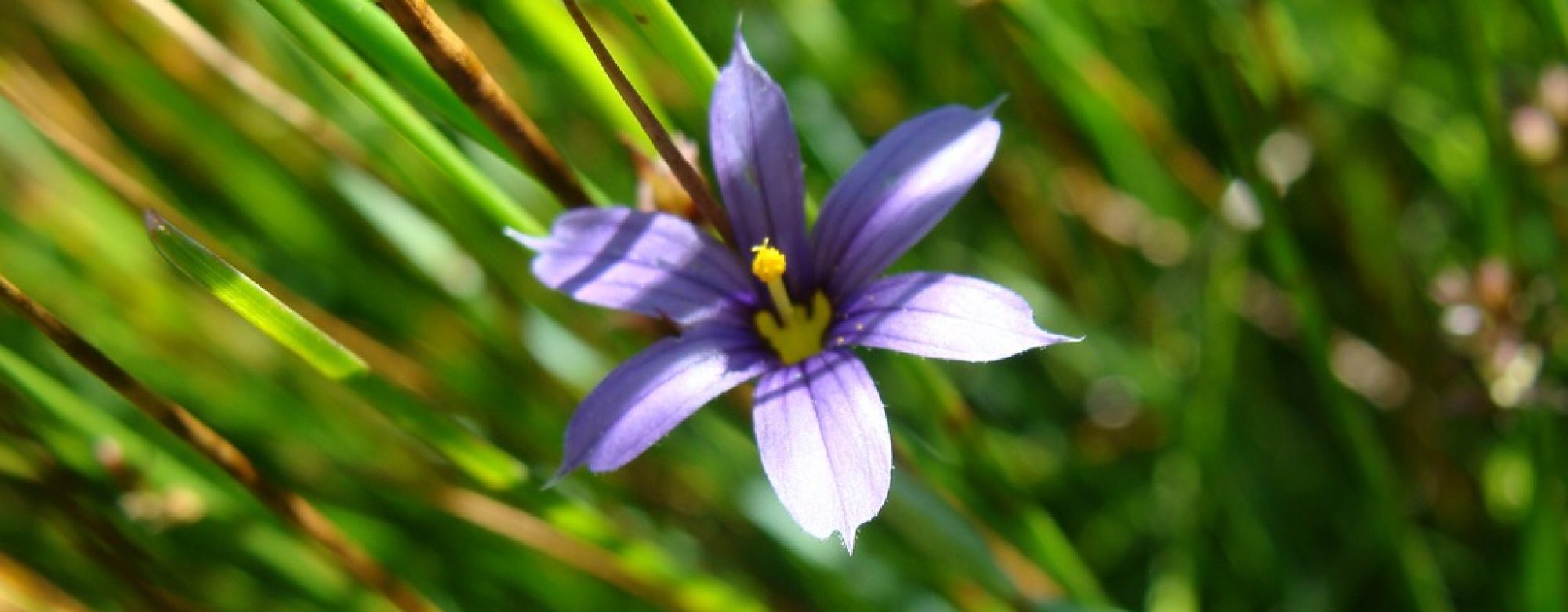
I left about a 3-foot blank area near the curb to accommodate parking/passengers. Behind that, I went all-in with fringecups (Tellima grandiflora). I planted two rows of them, with a mixed row of scarlet monkey flower (Erythranthe cardinalis) and blue-eyed grass (Sisyrinchium idahoense) in front.
I had too many tall phlox plants I started last year, so I popped three of them into this new garden, too. Pollinators love phlox, so they should be lively masses of insects by June/July.
I love taking a “before” photo of a freshly planted garden. They seem so sad, meek, and bleak. I’ll take photos again in June to see how things are doing.
I have a pot full of seedlings labeled Ocean Spray. I was trying to confirm online if they are, indeed, Holodiscus discolor. All my searches turned up no photos of just-germinated Holodiscus seedlings.
Here are photos of my seedlings. I’ll keep an eye on them and hope they turn into Ocean Sprays.
Ocean Spray (Holodiscus discolor) seedlings germinated in the middle of winter!
I am curious: after I post this, will AI and internet searches ever find this photograph?
This might be a bit of a stretch, but I am counting critters here that I have seen on this property or above it. I have seen one great blue heron (Ardea herodias) flying away from our property, and one on the neighbor’s house, gazing longingly at our koi pond. The photos here are not from my yard; they are from waterways around the area.
Our tiny koi pond somehow attracts herons, and we have to keep them out, or the fish will be gone. We hope they do not come to the yard. But they are spectacular birds, regardless.
I was motivated to list GBH as the critter of the day when I visited the Kenmore Park and Ride today and saw that the herons have returned to their rookery already for the 2026 breeding season.
This is a very widespread species with a range that includes North, Central, and parts of South America, the Caribbean, the Galapagos Islands, and the Azores. An all white version, known as the great white heron, is found in the Florida Keys. There are four other subspecies, as well, including the Pacific Northwest’s Ardea herodias fannini.
These largest of the local herons can be 36″ to 54″ long, 45″ to 54″ high, with a wingspan of 66″ to 79″. These are by far the largest birds around most of the time. These are majestic creatures until they open their beaks. They seem more like dinosaurs than any other local birds, and even their ridiculous squawking call brings pterodactyls to mind, though I have no idea what a pterodactyl really sounded like.
These big herons eat so many critters! Certainly fish is at the top of their menu, but they eat frogs, salamanders, snakes, lizards, turtles, rats, voles, gophers, rabbits and even other birds, such as ducks and rails!
Herons start their breeding behavior around here in December/January when they return to the rookeries, large trees where they place their communal nests. One benefit to their early start is that their breeding plumage materializes in the middle of winter, striking and bright against the gray Seattle weather. Rookeries can include up to 500 nests! They lay 3-6 eggs, usually by March or April. The eggs hatch after about 27 days. Male herons incubate the eggs in cooperation with the females.
These birds have few predators as adults, with eagles rarely taking them. The young and eggs are more vulnerable to other predators, including crows, ravens, vultures, hawks, and even black bears.
By planting more native flora around the neighborhoods, including near wetlands, we can improve the food webs that support great blue herons. We can also keep our waters healthy by not using chemicals in our yards and picking up our dog waste.
As mentioned in the previous post, many critters have been introduced to this area, and this ubiquitous spider, the cross orbweaver (Araneus diadematus) is one of them. This critter makes all the beautiful and/or annoying webs all over Seattle yards starting mid-summer and continuing through the autumn.
Introduced in the late 1800s, likely in shipping containers, these spiders have spread across the northern US and Canada and altered the ecosystems they inhabit. As mentioned earlier about the non-native species, this is another beauty that is hard to hate when you see how skilled they are at web-building. Many consider these spiders a positive addition to the landscape because they are presumed to reduce insect pests. Not that it matters now, with these spiders spread far and wide, but for those of us who don’t consider any insects pests, their benefits are not as obvious, and their potential harm to native ecosystems looms large.
You can clearly see the cross that has given these spiders their common name in the photo above.
These spiders breed and die as the weather chills, leaving egg sacs behind that hatch into hundreds of tiny yellow and black spiderlings the following spring. I often grab egg sacs and place them in the greenhouse in the fall so I will have all those great little spiderling predators eating pests in early spring.
The breeding behavior is fun to watch if you happen to catch it in process. The males sneak up on the females and ask to be let into the web. Like many spiders, they can easily be mistaken for food by the larger females. There is a fair amount of cautious questioning, plucking web strings, and making intentions known. Then, there is a brief and frantic interaction with tentative touching and tapping, and then a frantic deposit of sperm and escape. I caught a bit of the dance on video one time while I watched it unfold on our patio.
These spiders are not considered dangerous to humans, and I have had hundreds of them on my person over the years after accidentally walking through their webs, and have never, to my knowledge, been bitten. Along with egg sacs, I will sometimes pick up fat females with my bare hands late in the season and move them to the greenhouse.
The most impressive aspect of these spiders is their amazing web engineering. Sometimes the web spans what seems an impossible gap in the garden, six, eight feet, or more. Watching how they repair/improve the web every day is inspirational. Seeing a perfect web dripping with dew is an elegant sight of which I never tire.
Once in a while, I see a critter that I don’t believe is real. The common emerald (Hemithea aestivaria) is such a creature–a spectacularly beautiful and intricately accessorized moth that showed up on our porch one evening.
The common emerald is not a native moth; it was accidentally introduced to British Columbia in 1973 and has been spreading gradually across North America since then. It has a large natural range, including the Nearctic, Palearctic, and the Near East, and is most common in the southern half of Ireland and Great Britain.
While the hope in planting native flora is to improve habitat for native fauna, a side effect for me has been learning more about non-native fauna (and there is more of it than you might think!). While I try to eradicate invasive plants from my yard, I still have respect for non-natives. They are amazing species in their own right, and it is their admirable ability to succeed away from home that makes them a challenge.
Common emeralds have a wingspan of around 1.25 inches. They are on the wing in early summer (June/July).
While I will not be planting flora to feed common emerald larvae, it turns out they have a broad menu of host plants, from Aralia to Viburnum, with dozens of species in between. Many of those host plants are already in my garden.
I only see one or two of these moths each year. Each sighting fills me with joy and wonder! As the name suggests, this critter is a real gem.
I have highlighted a couple of birds so far. Without insects, though, there would not be birds. Butterflies are the superstars of the insect world. However, they are relatively rare in my yard/garden. Their numbers have been on the rise since I started planting native plants, though, so I am hopeful to see more and more.
My favorite local butterfly is the woodland skipper (Ochlodes sylvanodes), a small orange-and-brown butterfly native to the western US and Canada.
I used to see woodland skippers occasionally in summer on some of the ornamental plants in the garden. They seem particularly fond of asters. It was a rare and magical experience to see one. They are small for butterflies (wingspan around 1″), and they often rest on leaves or flowers with their wings open. They present a more practical image, rather than the extravagant, large-winged wonders that we think of when the word butterfly hits our brains. I find them cute, cheerful, perky, energetic, and a lot of fun.
Woodland skipper larvae feed on grasses. Knowing this, I planted a big patch of Leymus grass in 2020, and it has spread even more since then. I have not seen woodland skipper larvae on those grass plants. I have noticed the number of adult butterflies increasing in my yard over the last few years. There are summer days when I see five or six at a time, something I never used to see.
I am going to plant more native grasses and more asters in the spring to try to bring in even more skippers.
The highlighted species of today’s critter-a-day is the American crow, or Corvus brachyrhynchos. The real critter I am highlighting is a specific American crow who has been part of my life for almost 14 years, the brilliant and amazing critter I call Half Beak. The first photo I have of this incredible bird is below, dated June 2012! And I just saw her in the yard this week! Quite a run!
Over the last 30+ years, scientists have studied corvid (the crow bird family) intelligence and determined that they are incredibly smart and complex. Their brain-to-body size ratio is the same as humans. I think of Half Beak as a friend after all these years, not a wild bird. I can see the intelligence in her eyes, and I wonder what she thinks of us crazy humans when she watches me gardening or doing chores in front of the living room window.
I do not remember when we first noticed Half Beak. I imagine she was around the yard, and we noticed that her beak was malformed, so we started feeding her. I do remember we used to get the rotisserie chickens from the grocery store for $5.00 (how long ago that was!), and we would put the carcasses out for her on the lawn when we thought we’d eaten all the good stuff. Half Beak found more good stuff. She started hanging around, so we started supplementing the chicken with dry dog kibbles. She loves those, too.
We assume that Half Beak is a “she,” but there is no proof to support our assumption. We will likely never know for sure. In crows, the two sexes are very similar. There are differences in their behavior, size, and other traits, but Half Beak does not seem to care how we identify her as long as the kibbles keep flowing.
After knowing a creature for so long, we have some anecdotes that make us smile. For example, we were trapping rats after a rundown home in the neighborhood was leveled by bulldozers, and the rats ran to neighboring properties, including ours. We thought the dead rats might be a treat for the crows, so we set one out for Half Beak and her mate, Full Beak (We call all of her mates Full Beak–we have no idea if she’s had one mate or fourteen mates over the years!) Sure enough, the crows appeared thrilled…they ate the delicate, delicious parts of the rat and left the rest. Several days later, though, we noticed crow activity on the driveway, and when they cleared away, they had left us a fresh dead rat. Such a gift! Crows are known to bring all kinds of gifts to the humans they appreciate.
Another time, we had forgotten to put any kibble out. Half Beak was hangry. Leon was quietly reading in a chair just inside the living room window. He was startled when he heard loud cawing that seemed to come from inside the house. It turns out Half Beak was hanging upside down from the gutter above the window, screaming “FEED ME!” at him in crowanese. He did.
One of my favorite Half Beak moments came more recently. I was starting native plant seeds and was so proud that, for once, I included labels in the seed pots. I just happened to look out the bedroom window a few hours later to see my mischievous feathered friend up to no good:
I never did get those labels back where they belonged! Naughty girl!
Another trait to watch in Half Beak and her Full Beak mate is that they cache food in and around our lawn. If they have eaten their fill of kibble, they will take the food, dig a plug of grass out of the lawn, plant the food in the bare space, replace the plug, and add a leaf or two on top to hide the treat even further.
I am not sure the crows ever come back for the cached kibble. I do know that squirrels and neighbor dogs are unusually fond of our lawn.
Interestingly, crows are not among the better-studied birds in the world from a behavior standpoint because they are difficult to catch. They are just too smart. Their range covers virtually all of the US and Canada (except the tundra areas of the far north), and parts of northern Mexico.
American crows vary in size from 16″ to 21″, and their wing span can be 33″ to 39″. They can be distinguished from common ravens by their much smaller size (if you see them together), but also by some physical differences, especially in the heavier beak/heads of the raven, and in their flight pattern. Ravens tend to soar a lot more than crows. There are about five subspecies of crow with fairly subtle physical differences, including size variance and thicker and more slender bills.
One of the most noteworthy traits of crows is their winter roosting habit; thousands or even millions of birds will fly near dusk to their roosting spot. I experienced this at the University of Washington Campus near Bothell, and it was unbelievable. The cacophony and the vast number of birds were almost impossible to believe. And then, just after dark, silence. It was magical.
I was recently on a business trip to Oakland, CA, and while walking the streets at night, saw that crows were roosting in the street trees–tall sycamores deep in the heart of the city. They had found a way to make do.
Unfortunately, these birds can be too smart for their own good. They have raided crops and maddened farmers to the point where whole states have tried to eradicate them, even using dynamite to blast them out of roost trees. Horrible. Luckily, eradication has failed so most farmers have given up.
While crows seem incredibly common, their population has been decimated by the awful West Nile Virus that hit the US in 1999 and has been killing birds here ever since. Crow populations are down an estimated 45%, which is hard to believe when you see so many crows around! I’m grateful that Half Beak has avoided fatality from this disease.
We know that Half Beak breeds every year and raises young. We have even seen one of her offspring with a similarly shaped beak. Crows can mate as early as April, making bulky stick nests sitting in trees. It is shocking when the leaves fall in autumn, and you see a crow’s nest in a tree–this big, bulky mass that you never noticed before. The birds lay three to six eggs. Incubation lasts about 18 days, and the young fledge in just over a month.
Around my neighborhood, leaving the nest is the worst time for crows. The babies often fall from the nest before they are fully able to fly, and they get caught up in all manner of trouble, from cat predation to car strikes. I have angered crow families by trying to move fallen babies off the street. The parents take years to forgive me and will chase me down the street for a full year before they start to trust me again.
Crow families stick together for years. Last year’s young help raise this year’s young sometimes. The average lifespan of a wild crow is thought to be seven years, but they have been known to live to 40!
Crows recognize individual people, and they will be your friend if you do not scare them and you feed them. If you want them to nest on your property, you need to have some decent-sized trees for the nests. Developing a habitat that supports the insects and small mammals they need to raise their young will also encourage them to stick around. I’m hoping Half Beak sticks around for a few more decades. I look forward to our time together, working to figure each other out.
I decided to highlight a critter every day from my yard to highlight the organisms that bless me with their presence since I started planting native flora. I realize this will be a significant undertaking, and I am already behind schedule. I am really looking forward to it!
I’m kicking off with birds that are my constant companions in the garden now, dark-eyed juncos (Junco hymenalis).
The dark-eyed junco is a variable species that is widely distributed in the mainland U.S., Alaska, and Canada. They can be 5″ to 7″ long. Around my house, the females resemble the bird above, and the males resemble the one below.
The birds appear completely different in other areas of their range, with 14 to 15 subspecies described, including morphs in the following groups: slate-colored, white-winged, brown-backed, pink-sided, gray-headed, and red-backed. Isn’t evolution amazing!
These juncos forage on the ground, and in winter can be seen foraging in groups. Their diet is made up of seeds and insects, with insects dominating during the breeding season and as the diet for young birds. Berries are also occasionally on the menu.
While they normally nest in a 4″ diameter cup-like nest on the ground, the nests can be found low in trees, or in various out-of-the-way places (and sometimes very in-the-way places) around homes and yards, like in window boxes and hanging baskets. The eggs can vary in appearance, but the local ones appear mostly white with some dark speckles. They hatch in 12-13 days. Baby birds fledge in less than two weeks. Pairs will produce multiple broods each year. I had a pair I named June and Pete (my parents’ names) that bred in our yard last spring/summer and had at least three broods.
The reason I wanted to honor these birds as my first Critter-A-Day post is that they are doing so well in my yard lately. I see them all the time and often have multiple pairs nesting around the property during the spring/summer. Several times, they’ve made nests in my greenhouse in hanging baskets and in the neighbor’s window boxes. They also nested right on the ground in the native plant garden last year. They bring a lot of interest and cheer to the garden, always busy and always watching. They are handsome birds, too, dressed in Seattle colors, but making them somehow very showy.
Some juncos migrate south, or down mountains, and some do not. It depends on the weather and can vary from year to year. I’m grateful they seem to stick around my yard pretty much all the time!
The impacts of urbanization have been studied in a population of dark-eyed juncos in California, and the results are fascinating. The urban populations, over what appears to have been just 20-30 generations, have developed a higher tolerance for heavy metals. Heavy metals are a dangerous obstacle for city birds, so this genetic tolerance allows the birds to overcome this danger.
In addition, this group of juncos has a gene that supports higher-pitched calls. This trait is beneficial in city environments with low-frequency urban noises that drown out lower-pitched bird calls.
I hope you all will look around for these unassuming little birds that are adapting to our neighborhoods and succeeding in our gardens. Plant some native shrubs for them to perch in, and some small trees from which they can launch their trilling songs. And most of all, leave the garden debris on the ground because the insects they need are hiding there, and watching these efficient little hunters find them is an unmatched joy.
The tradition of sowing native plant seeds between Christmas and New Year’s is alive and well here at the Peterson pseudo-nursery. Since late summer, I have collected seeds, placed them with moist soil in plastic bags, and stashed them in a refrigerator drawer, just waiting for this week. And I was particularly good at collecting this year! Look at this bunch of seeds waiting for sowing!
I prepped some soil, adding fir needles from the garden and some soil from under the Douglas fir that should have lots of mycelium in it!
Here are a few of the planted seed pots in their fancy gift bag covers.
The seeds include locally collected osoberry, Oregon grape, snowberry, native roses, Douglas asters, Puget gumweed, fleabane, dogwood, madrona, western columbine, western bleeding heart, vine maple, red alder, western red cedar, and others.
I love this tradition, as it celebrates native plants and gives me something to look forward to as the days start to lengthen. Some of the refrigerated seeds were already sprouting, including the Collinsia and Lupine seeds. They are so hardy, the refrigerator feels like spring to them!
If there are decent germination rates, I will be potting on seedlings madly for the rest of my days! I hope! That is my retirement dream!
I encourage anyone reading this to plant some native plants this week between Christmas and New Year’s to celebrate! Planting native seeds holds the promise of spring and the promise of healthy local ecosystems! Happy 2026!
Summers seem so hot and dry here in Seattle now that the long-awaited break in the weather is cause for celebration. It is also a trigger for lots of work!
Based on the weather, it is safe to plant out native seedlings/starts now for the fall planting season. I clawed back some of the Leymus grass in our native plant garden and planted the recovered ground with yarrows, monkey flowers, blue-eyed grass, Oregon sunshine, and lupines.
While I was digging, I found this gorgeous little guy. Caterpillars are like platinum when it comes to food webs–they are incredibly valuable! So excited to see this one!
I set about 20 seedlings out on my free plant wall of blue-eyed grass, yarrow, columbines, and lupines. It took a few days, but the neighbors took them all. One woman caught me gardening later and thanked me for them. She was excited to get a new western columbine, as she had one that perished. She was excited to try the blue-eyed grass, too. It was nice to hear her enthusiasm.
I am excited to start even more native plants in 2026. I have been gathering seeds from nearby natives and have ordered a bunch of seeds from Etsy and other sources, as well. I will be trying multiple stratification methods this year, along with my usual holiday week seed planting event to ensure I get lots and lots of seedlings to plant and give away. I didn’t count all the plants I gave away this year, but I would guess it was close to 100 total…I will hope to more than double that next year. Little by little, my free native nursery will make a difference!