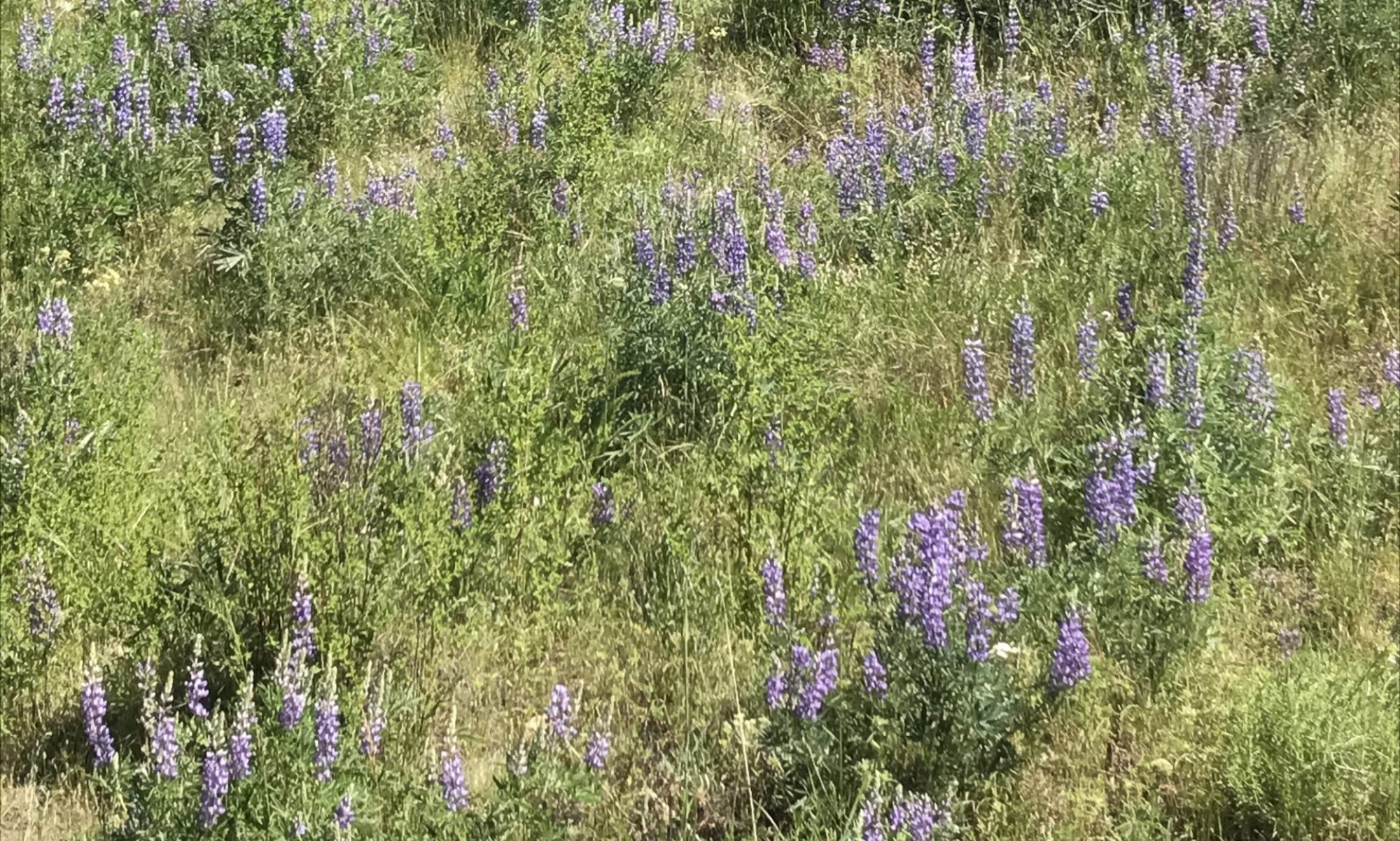
Wetter, cooler weather is coming. The timing seemed right for planting natives in the garden and lawn today.
My experiment to add natives to the lawn includes Douglas aster and Puget gumweed seedlings planted in a wide strip toward the street. This will allow me to mow low around them but keep the strip they are in longer.
Here is what it looked like today.
These two robust native should be able to survive living in a lawn as long as they get to grow a few inches tall. Come summer, I expect them to bloom on stocky, short stems. I may plant camas bulbs along that same strip when they land in November. Stay tuned to so how this experiment plays out.
More than three dozen seedlings were planted in the lawn. Additional plants were placed in the native plant garden. They include fringecups, Iris tenax, western columbine, sticky cinquefoil, and large-leaved lupines.
Funnily enough, a woman saw me planting natives and asked if I was just planting today or if I was giving plants away! She knows we give away native plants. That made me smile. I confirmed that there would be a giveaway today. I rounded up 21 native starts and putting them out for free.
ChatGPT helped me design the fliers describing the plants. There were bitter cherry, osoberry, fringecup, red-flowered currants, tall Oregon grape, and one pot of salal. I am hoping the starts will all be gone by tomorrow afternoon! And just in time, since I grabbed a bunch of tall Oregon grape and madrone seeds on my walk today! I need room for new seeds/seedlings!
Last year, I picked Oregon grape berries here in the yard and around the neighborhood. I potted them up, protected them from birds, and virtually every seed germinated! Ultimately, three pots full of Oregon grape seedlings were my prize, each with about 50 plants! I endeavored to pot them all on this past weekend.
Because there were so many, I potted three seedlings in each 3-1/2″ pot. I expect this will produce fuller transplants to send on to restoration projects. These seedlings ultimately grow into multi-stemmed shrubs, so this is a way to expedite that process. The other benefit is that if one or two seedlings don’t make it for some reason, there will still be a good strong one to plant out. In reality, I don’t have the resources or room to plant them/keep them individually!
In late summer, I was starting to wonder if I’d done something wrong with the native plant garden. There were hardly any “they” coming, despite me planting it–almost no birds at all. Luckily, in the last two weeks, along with cooler weather and shorter days, along came all the birds!
One of my favorite birds passing through the neighborhood this time of year are the brown creepers! They are so unassuming and so perfectly designed! It feels like good luck when I spot one, which I did last week on the western red cedars across the street.
I also heard an evening grosbeak in the Douglas fir next door last week, the first time I’ve noticed that bird in the neighborhood.
The crows were mobbing a raptor in the 80-foot fir tree across the street today and I got a photo. I see a red tail here, so suspect it might be a red tailed hawk, but never saw it fly away to confirm. Pretty exciting to have such a beautiful bird so close!
There are some fireweed (Chamaenerion angustifolium) plants at Ingraham High School, and they were particularly beautiful in the light this evening. This is an easy plant to grow once established, and it will spread nicely and create a better show each year, making lots of food for pollinators and a fantastic floral display.
July may not be the ideal time to transplant native seedlings. My gardening calendar is imperfect, for sure, and often focuses more on when I have time rather than when the plants need attention. So, the last few days I have been potting some native seedlings on, including Puget gumweed, sticky cinquefoil, yarrow, Douglas aster, and Cornus sericea. There are many more to go, but most can wait for cooler, wetter weather. These particular seedlings seemed to be stalled out and desperate. I hope I haven’t done them any harm.
These are some seedlings I potted on weeks ago, including Osoberry and Ocean Spray. They appear to be settling into their new pots well and should be ready for a give-away event in the autumn.
My favorite little seedlings are the Pacific madrone tree seedlings, Arbutus menziesii.
And a lovely reminder of why we plant these landed in front of me while I watered some pots today–a single-dotted wave moth!
Probably the showiest native flower blooming in July is the fireweed clump in the native plant garden–just spectacular with the sun behind it. The stems are six feet tall or more.
This clump was started from a division my brother provided a few years ago. It seemed like it might be dying out, but then it spread nicely last year and has about ten stems now with loads of flowers.
Targets are useful for helping homeowners understand what makes up a useful level of biodiversity in our yards. The target set by Doug Tallamy and others is 70%. I never really explored what that meant, or how it should be measured.
Recently, though, I was listening to a podcast about planting natives, and the speaker mentioned that the metric is biomass, not the number of plants or species.
While it has felt like “wilding” our yard has been a slow process, the podcast made me realize that I am likely already at 70% with the giant Douglas fir tree on our property. It weighs thousands of pounds and has millions of needles, miles of needles. I really notice how huge it is when it creates a blizzard of pollen cones. They are covering the edge of the street and dropping onto all the gardens under the tree, giving an organic boost to the soil all around.
I won’t stop adding natives to my yard, but this was a nice reminder of how important that wonderful, huge tree is to the neighborhood’s biodiversity. Everyone should consider adding a large native tree to their yard–they grow faster than you think.
I have a bunch of not-quite-native plants that I started from seed last year–scarlet monkey flowers, Erythranthe cardinalis. My research was poor, and I was sure this was a locally native species. After I grew a few dozen of them from seed, I researched them again and realized they were native to Oregon and California, not to the Seattle area. But I couldn’t waste them. I planted them around the yard. Now they are blooming for the first time, and they are beautiful! Interesting and bright. And the hummingbirds love them.
No regrets on these plants now, but I will be more thorough in my research going forward!
The seedlings keep popping up in my native seed pots. It seems clear that the germination guides I found online for each species were accurate, and the extra effort to follow those guides was well worth it. Here are some of the seedlings, looking healthy and strong:
Seedlings here include a year-old cascara tree, western buttercup, fringecup, Douglas aster, madrone, vine maple, Oregon grapes (2 pots), osoberry, ocean spray, and pacific crab apple.
There are hundreds of other seedlings, too, including western hemlock, western red cedar, and western columbine.
There are some lovely native blooms around the garden this month, so I will drop some photos here for you to share their amazing beauty.
Western columbineLarge-leaved lupineCamas with a native bee.Piggy-back plantCheckermallowWild rye and columbineBitter cherryViola aduncaSeep monkey flowerRiverbank lupineFringecupGarry oakYarrowCheckermallowLarge-leaved avens
Our yard, the ecosystem we live in, is full of birds lately. Likely, many are breeding in our yard or very nearby. Here are a few photos from the yard this week.
Bushtit with caterpillarBlack-capped chickadeeWell-hidden Anna’s hummingbird
Having a wild and native-planted yard really does bring the birds in. I always find birds like the bushtit above in the madrone tree that sprang up under our Douglas fir. While I walk Rafa every day, I see which yards have birds and which ones have few/none. It seems so simple. The yards with big native trees have birds. The yards with native shrubs and perennials have birds. And the messier yards, the ones with thickets and brambles, have many birds. The yards with perfect lawns and few/well-clipped shrubs and trees, have few birds.
When I see the local merlins, they are in the tallest Douglas fir trees, along with band-tailed pigeons. The Douglas fir trees in the neighborhood are always atwitter with chickadees, kinglets, and nuthatches. And the American robin male sings from the top of the western red cedar across the street. They all have other trees they can choose, but they are drawn to the trees they know best, the ones they evolved alongside.
Our brave and barky dog announced a visitor at the front door last week. It turned out to be Mark, a neighbor from about four blocks down 137th. I had noticed a lot of changes around his yard and parking strip in my walks to and from the bus. Mark wanted gardening advice. He had been trying to grow things in his newly de-lawned parking strip, but nothing much seemed to be taking root. His goal with the parking strip is to reduce maintenance and add beauty–a perfect place for Seattle native plants! I told Mark I would gather up some plants and seeds for him and get back to him soon.
It is not the best time to share plants. Most of my seedlings are all too small to share. But I had enough larger seedlings and plants left over from last year to give him a tray of columbines, lupines, Oregon sunshine, Douglas aster, and houndstongue–21 plants in all.
I dropped these off at Mark’s house and texted him planting instructions. Within a day, they were planted in his sad, bare parking strip, making it just a little less sad. Mark’s parking strip holds so much potential!
Mark mentioned that friends and neighbors had recommended certain seeds to plant, but glancing around, I only saw some sunflowers and poppies, and very few of those. So I jumped online and ordered some big seed packets from Eden Brothers. I dropped those off with him today, including quick-to-flower types, and more pure native blends that will take a year or two to establish.
What a great opportunity to add another parking strip to our neighborhood’s native habitat. There is another de-lawned parking strip a block away from Mark’s place. Who knows, maybe I can convince them to go native, too!
Stuart, who is just two houses away from us, has the purest native garden and parking strip, and it is blooming beautifully right now. Really beautiful! Neighbors are getting the message, or at least are open to trying native plants — the result is the same for native fauna.
Here are a few blooms this week in my own modest native garden.
Spring can be overwhelming for Seattleites. We hibernate all winter, then the days stretch a little, and the sun pops out, and suddenly we are trying to finish a million garden chores in a single day. Or is that just me?
I managed to take a little time this spring to look around my own native plant garden, native plantings at the North Acre dog park, and around Twin Ponds. Seeing spring unfold in these places is such a joy. Here are some photos of the beauty I’ve noticed.
Oregon GrapeRed-flowered currant, pink cultivar in my native plant gardenSalmonberry blooms near Twin Ponds.Maianthemum dilatatum at Twin PondsMadrone tree, Arbutus menziesii, grown from a bird-sown seed under our Douglas fir tree, blooming beautifully!Trailing blackberry at North Acres. Bracken ferns, Pteridium aquilinum, are taken for granted as a weedy fern. But they are extraordinarily graceful when they unfurl in spring. These are at North Acres.Elderberry blooming at North Acres. Stinging nettle is blooming at North Acres.Western bleeding heart blooming at North Acres.Native pollinator coming in for a landing…heavy bumble bee.This bee is a perfect fit! Exactly why native plants are so important.This tree snag is full of fungus. Unfortunately, ivy is also taking over this tree. The folks who help curate North Acres will likely cut down all the ivy soon.Western red cedar has a special grace when it leafs out (needles out?) in spring. This one is at North Acres.Trillium ovatum blooming in my native plant garden. This is a fresh white flower.Trillium flower aging perfectly at North Acres.Fringecup (Tellima grandiflora) is blooming in my native plant garden. It is one of my favorites. It comes easily from seed, survives in dry shade under trees, and has showy, graceful flowers that are attractive to native pollinators.Another favorite–this one in my memory garden in the parking strip–large-leaved avens, Geum macrophyllum. Very easy from seed, simple to grow (weedy, some would say), and lovely in flower and seed. I almost forgot about this Amelanchier alnifolia in my native plant garden. It is pretty spindly still, and unassuming, but it is growing very well and blooming impressively this year.The piggyback plant, Tolmiea menziesii, is blooming in my native plant garden. The flowers are so delicate and interesting.Seep monkey flower in the new native plant garden in front of Leon’s studio. The flowers will be open in a few days, lots of them!
Native plant propagation is going very well this year–many pots of seedlings that will need to be potted on and cared for, including madrone, western buttercup, western columbine, Douglas aster, biscuitroot, yarrow, osoberry, fringecup, vine maple, oceanspray, choke cherry, western hemlock, red alder, western red cedar, and showy fleabane! I am so excited for all the tree seedlings, especially as I haven’t had much luck with them before.
In addition to seeds, I took cuttings of Douglas aster over the last few weeks and potted them up from my boisterous clumps around the yard. Some will already be rooted by now — they grow quickly as long as I keep them moist.
The “They” in “If You Plant It, They Will Come” have definitely been showing up in numbers here in the yard. We had two dark-eyed junco nests (both sadly raided, but early enough they will likely begin again), for sure, and Bewick’s wrens nesting in a box near Leon’s Bedrock studio. In addition, I believe the following are nesting on our property or very near: spotted towhees, bushtits, house finches, song sparrows, and red-breasted nuthatches. And I heard flickers in the Norway maple across the street where a pair nested last year. It looks promising that they will raise young there again! The crows are all over the yard/neighborhood, but I haven’t seen their nest yet. I also hear a male robin singing his heart out morning and night.
All of that to say that nature really wants a chance. She just keeps trying. And if we give her space, help her out a bit, she’ll make amazing things happen right in front of our astonished eyes.
Part of my goal with IfYouPlantIt is to get more native plants out in the neighborhood. I have a surplus of fringecup plants and so set about 14 of them out for the neighbors to take. Let’s hope they take advantage of this opportunity!
Not far from the free plant staging area, one of the TheyWillCome representatives was huddling in the shrubs, but also calling and showing off. I am hoping we’ll have a bushtit nest and some babies this year.
Bushtits build one of the most amazing nests–a hanging sack of moss and lichen far bigger than the birds that craft them, with a very soft lining. Unfortunately, crows and jays often find and destroy nests, eating the babies inside. Obviously, they often succeed, though — we have a lot of bushtits around! Hoping they succeed in our yard this year.
When I started propagating native plants, I hadn’t anticipated how long some of them might take to mature and bloom. Grass widows (Olsynium douglasii) are a perfect example. My oldest seedlings are probably five years old now. They seem tiny and fragile. Because of that, I’ve kept them in pots outside. I see their leaves pop up every year and they only seem a tiny bit bigger and more robust each year.
But this year, one of them was more robust than the others! And it flowered! My first grass widow flowers ever. I have never seen this plant growing wild.
Such a beautiful plant when it blooms; it is very grass-like otherwise, which is likely its survival strategy.
Looking around my seed pots, I found myriad seedlings popping up! They hold so much promise (and so much effort in getting them all to planting-out size!)!
Most of these were started in the summer or autumn last year, and some were planted at the end of 2025 as part of my holiday seed starting fest.
This is just a small sampling–there are hundreds of others! Easily 1,000 overall! Tony’s unofficial native nursery is in full swing!
Remember that some natives can be planted in the spring; the Pacific Northwest pollinator mixes are good candidates for spring sowing. Some options are below. And mark your calendar for purchasing some fall-planted seeds at the same time.